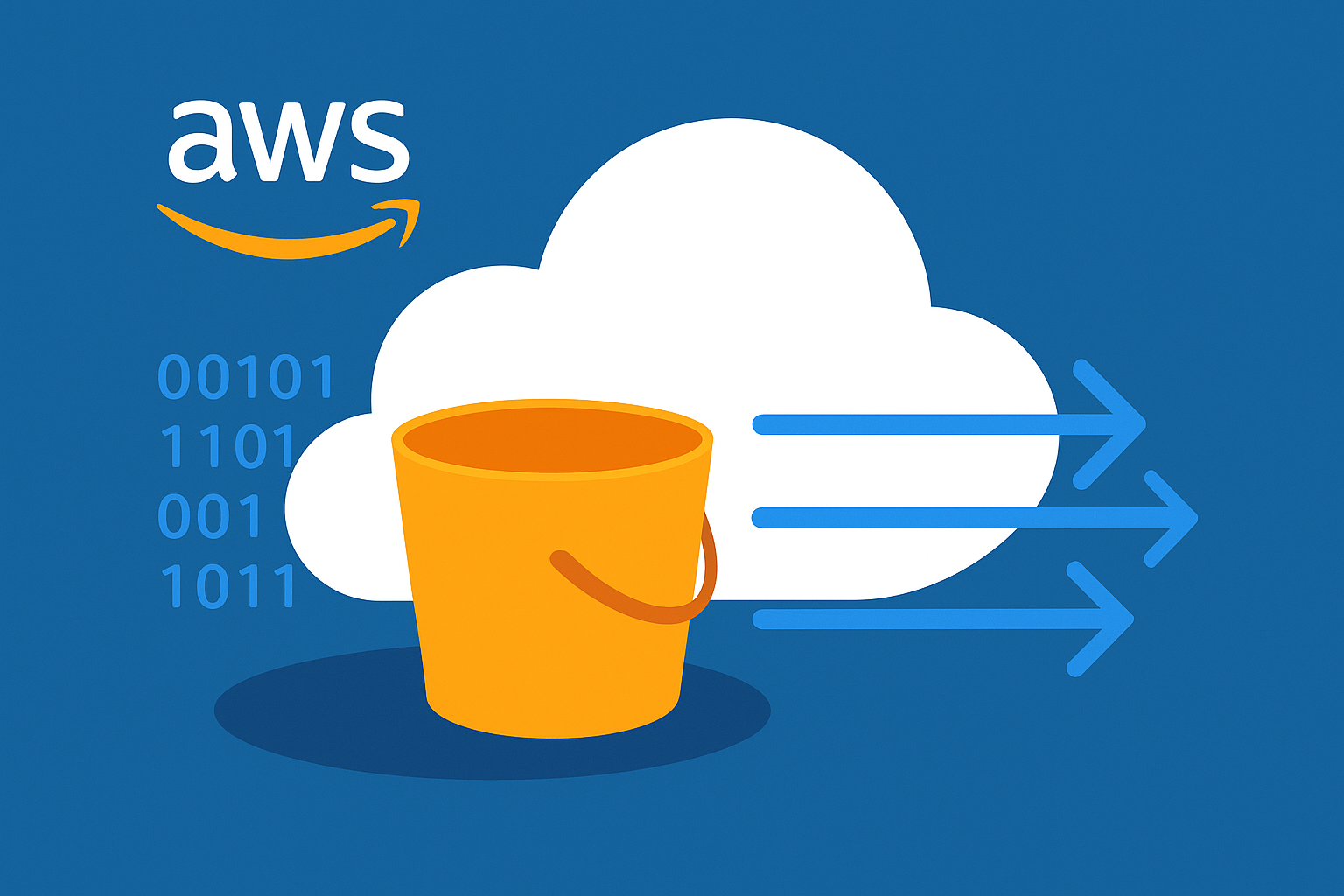
When most developers hear Amazon S3 (Simple Storage Service), they think of it as just an object storage solution. While it is indeed one of the most reliable and cost-effective storage platforms available, S3 has evolved into something far more powerful—a backbone for modern applications, data lakes, and even serverless architectures.
What is Amazon S3?
Amazon S3 is a fully managed object storage service that allows you to store and retrieve any amount of data from anywhere on the web. Each file, or “object,” is stored inside a bucket, and AWS ensures durability of 99.999999999% (11 nines), making data loss practically impossible.
Key Features of Amazon S3
- Scalability: Automatically handles billions of objects without capacity planning.
- Security: Built-in encryption, IAM roles, and fine-grained access policies.
- Cost Optimization: Multiple storage classes—Standard, Intelligent-Tiering, Glacier, Deep Archive—help reduce costs.
- Event-Driven Architecture: Triggers AWS Lambda functions upon object creation or deletion.
- Analytics Integration: Seamless use with Athena, Redshift, and EMR for querying and analytics.
Real-World Use Cases
- Backup and Recovery – Enterprises rely on S3 for mission-critical backups.
- Static Website Hosting – Deploy websites directly from an S3 bucket.
- Big Data Storage – Store raw or structured data in S3 for downstream analytics.
- Serverless Workflows – Combine S3 with Lambda to build automated pipelines.
Example: Hosting a Static Website on S3
Create a bucket with a unique name.
Enable Static Website Hosting.
Upload HTML, CSS, and JavaScript files.
Update the bucket policy for public access (if needed).
Access your site via the S3 endpoint or connect it with Route 53.
Why Choose Amazon S3?
Unlike traditional storage, Amazon S3 isn’t just a file repository. It’s deeply integrated across the AWS ecosystem—powering CDN distribution via CloudFront, enabling AI/ML pipelines with SageMaker, and supporting ETL jobs with Glue.
✅ Conclusion: Amazon S3 isn’t just storage—it’s a foundation for cloud-native applications. Whether you’re running analytics pipelines, hosting websites, or managing backups, S3 provides the scalability, durability, and flexibility you need.