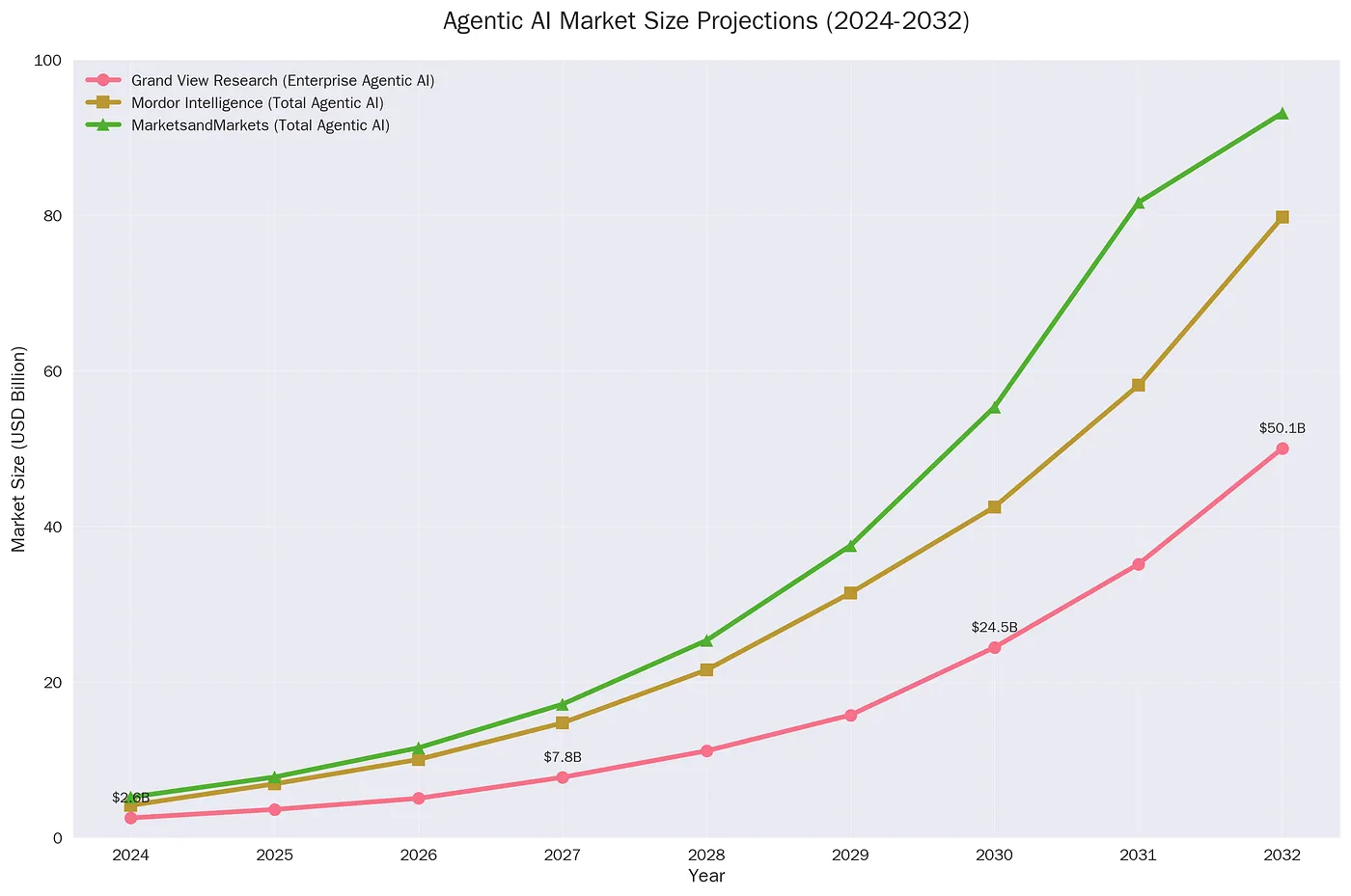
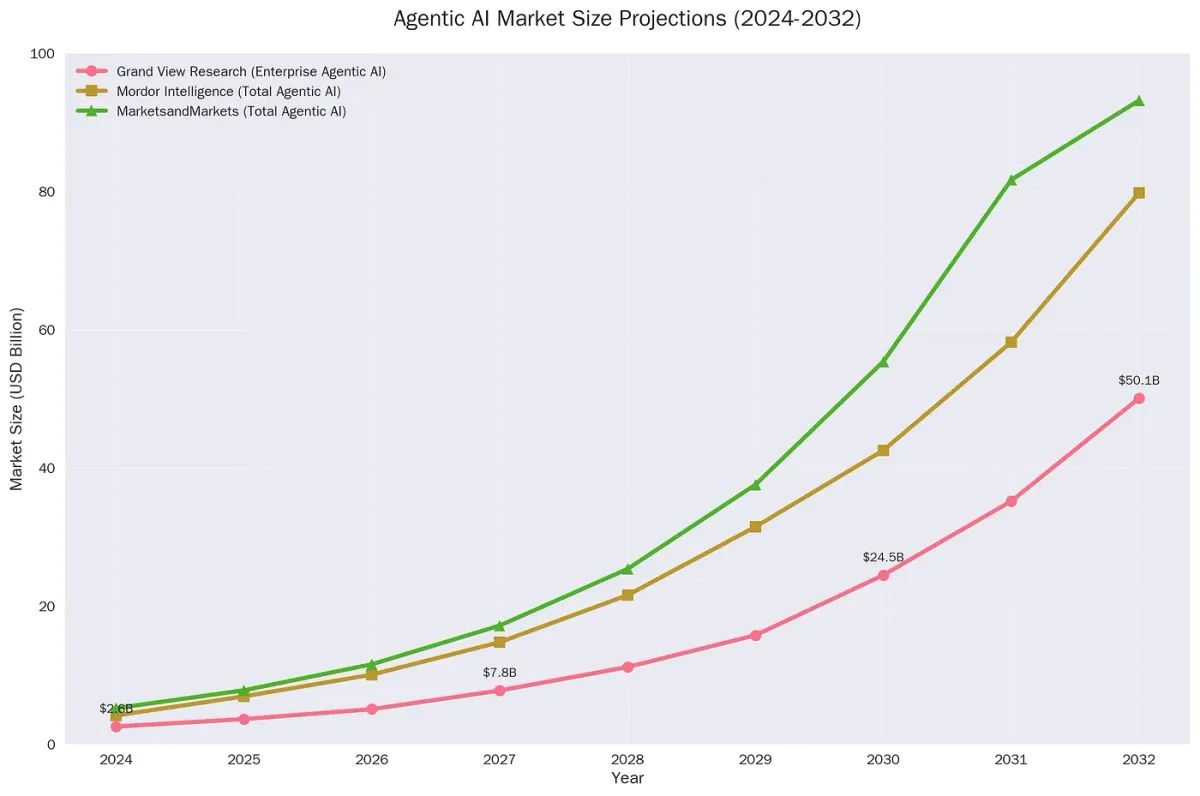
The agentic AI market is projected to experience explosive growth, reaching nearly $100 billion by the early 2030s. Source: Grand View Research, Mordor Intelligence, MarketsandMarkets.
Imagine a digital workforce that doesn’t just respond to your commands but anticipates needs, orchestrates complex workflows across your entire software stack, and even pays for its own resources in real-time. This isn’t a scene from a sci-fi novel. This is the world of agentic artificial intelligence (AI) in 2025, a paradigm shift that is quietly moving from research labs into the core of enterprise operations and the decentralized web.
While generative AI taught computers to write and create like humans, agentic AI is teaching them to act. These autonomous systems are not mere tools; they are becoming digital teammates, capable of planning, reasoning, and executing tasks that once required teams of people. From managing complex financial trades on Wall Street to orchestrating global supply chains and enabling a new machine-to-machine economy on the blockchain, the agentic revolution is here.
But with this newfound autonomy comes a new set of challenges. How do we ensure these agents are secure? How do we govern their decisions? And what does this mean for the future of work and the very structure of our organizations? This article dives deep into the technical breakthroughs, business transformations, and profound questions shaping this new frontier.
What Makes AI ‘Agentic’? The Leap from Reactive to Proactive
For the past few years, we’ve grown accustomed to generative AI like ChatGPT—powerful tools that can draft an email, write code, or summarize a dense report on command. These models are reactive; they wait for a prompt and deliver an output.
Agentic AI is different. It’s proactive.
An agentic system possesses a set of core capabilities that allow it to operate with a significant degree of autonomy:
- Perception: It ingests and understands its environment through data, documents, and APIs.
- Memory: It maintains both short-term context for the task at hand and long-term knowledge from past experiences.
- Planning & Reasoning: It can decompose a high-level goal (e.g., “increase sales for our new product”) into a series of concrete steps.
- Action & Tool Use: It can execute those steps by calling APIs, accessing databases, and interacting with other software—just like a human would.
- Coordination: It can work in concert with other agents, forming a collaborative digital workforce.
This shift is akin to the difference between giving a junior analyst a specific task and giving a project manager a strategic objective. The analyst executes a command; the manager plans, delegates, and drives toward an outcome. As enterprises are discovering, deploying agentic AI is less about installing a new piece of software and more about onboarding a new type of employee.
The Technical Breakthroughs of 2025: Powering the Revolution
This leap in capability hasn’t happened in a vacuum. A series of stunning technical breakthroughs in 2025 have converged to make agentic AI not just possible, but practical and economically viable.
1. Recursive Language Models (RLMs): Conquering the Context Window
One of the biggest limitations of previous large language models (LLMs) was their struggle with very long contexts. An AI asked to analyze a 500-page document would often “forget” information from the beginning by the time it reached the end.
Recursive Language Models (RLMs), pioneered by researcher Alex L. Zhang, have shattered this barrier. Instead of feeding the entire context to the model at once, RLMs treat the context as a programmable environment. The agent can “grep” through the text, spawn sub-queries on specific chunks, and recursively call itself to synthesize findings.
The results are staggering. On the OOLONG benchmark, a long-context reasoning test, an RLM achieved 64.9% accuracy on a 132,000-token task, more than doubling the 30.3% score of the state-of-the-art GPT-5 model. For businesses, this means agents can now reliably perform deep research across vast internal knowledge bases, legal discovery documents, or complex financial reports.
2. LightReasoner: Making AI Smarter, Faster, and Cheaper
Training powerful AI models has historically been a brute-force process, requiring massive datasets and astronomical compute power. LightReasoner, a framework introduced in 2025, turns this on its head with a counter-intuitive approach: using small language models (SLMs) to teach large ones.
The SLM acts as a “scout,” identifying the specific “reasoning moments” where the more powerful LLM struggles. By focusing the training process exclusively on these high-value moments, LightReasoner has achieved up to a 28.1% improvement in reasoning accuracy on math benchmarks while reducing training time by 90% and data requirements by 80%. This makes it dramatically cheaper and faster for companies to adapt and specialize agents for their unique needs.
3. SpikingBrain1.0: Brain-Inspired AI for Unprecedented Efficiency
While most of the AI world has been building on the Transformer architecture, researchers at the Chinese Academy of Sciences unveiled SpikingBrain1.0, a brain-inspired model that uses “spiking neurons.” This event-driven approach is radically more efficient for certain tasks.
The model boasts a >100x speedup in time-to-first-token on massive 4-million-token sequences and operates with roughly 69% sparsity, meaning most of its “neurons” are inactive at any given moment, mimicking the efficiency of the human brain. Perhaps most strategically, it was trained on domestic MetaX chips, signaling a potential path to high-performance AI that is not dependent on a single-source of GPUs. While independent validation is still needed, SpikingBrain offers a glimpse into a more energy-efficient and hardware-diverse future for AI.
The Blockchain Integration: A New Economy for Machines
As agents become more autonomous, they need a native way to interact with the economy. They need to pay for API calls, purchase data, and transact with other agents securely and without human intervention. The existing financial system, with its reliance on credit cards and manual account setups, is a major bottleneck.
This is where blockchain and Web3 are playing a transformative role, giving rise to a new machine-to-machine (M2M) economy.
x402: The Payment Protocol for the Agentic Internet
For decades, the HTTP 402 “Payment Required” status code sat unused in browsers. In 2025, it was brought to life by protocols like x402.
Integrated with Google’s Agentic Payments Protocol (AP2), x402 allows an AI agent to request a resource from a server. If payment is required, the server responds with a 402 error and payment instructions. The agent can then autonomously pay the invoice—often a micropayment of a fraction of a cent—using a stablecoin like USDC and retry the request.
 The x402 protocol enables frictionless, autonomous micropayments, forming the bedrock of a new machine-to-machine economy. This is just one example of the productivity gains being unlocked. Source: Coinbase, Google.
This simple, elegant flow is revolutionary. It eliminates the need for API keys, prepaid credits, and subscription management. Every API call becomes a metered, pay-per-use transaction with instant settlement on the blockchain. For businesses, this unlocks new revenue models; for agents, it provides a frictionless way to access and pay for the resources they need to complete their tasks. The uptake has been explosive, with one report citing a >10,000% surge in x402 transactions in a single month.
GoKite AI: The L1 Blockchain Built for Agents
To truly scale, agentic systems need more than just payments; they need a foundational layer for identity, governance, and security. GoKite AI is building a Layer-1 blockchain specifically designed to be the infrastructure for the agentic internet.
Kite provides agents with a verifiable cryptographic identity, allowing them to build reputation and trust. It offers programmable governance, enabling developers to set granular permissions, spend limits, and safety guardrails directly on-chain. By combining this with near-instant, low-fee stablecoin transfers, Kite aims to create a secure and scalable environment where enterprises can deploy autonomous agents with confidence.
Business Transformation: Case Studies from the Front Lines
The impact of agentic AI is not theoretical; it’s already being measured on the balance sheets of the world’s leading companies. The market for enterprise agentic AI is projected to soar from $5.25 billion in 2025 to over $199 billion by 2032, a staggering CAGR of nearly 50%.
 Market projections for agentic AI show a steep and consistent growth trajectory across all major analyst firms. Source: Grand View Research, Mordor Intelligence, MarketsandMarkets.
Here’s how different industries are being transformed:
Finance: Autonomous Traders and AI-Powered Compliance
Wall Street has been an aggressive early adopter. Goldman Sachs is using agentic systems to enhance its trading operations, reducing trade signal latency from 120 milliseconds to just 14 milliseconds. Their compliance agents have cut false positives in anti-money laundering (AML) monitoring by over 35%.
JPMorgan Chase is rolling out an internally governed suite of AI agents to its workforce, with reports of tasks like creating presentations being cut from hours to minutes.
Retail and Supply Chain: The Rise of “Super Agents”
Walmart is consolidating its myriad of AI tools into four “super agents”—for customers, associates, engineers, and suppliers. The goal is to create a unified, scalable AI infrastructure that can orchestrate everything from personalized customer experiences to optimizing logistics with suppliers.
Similarly, Amazon Web Services (AWS) has demonstrated how persona-based supply chain agents (e.g., a “Logistics Agent,” an “Inventory Agent”) can collaborate to reduce manual reconciliation work by up to 50% and cut overall logistics spend by 3-5%.
 Industry adoption is led by BFSI and customer service, with healthcare and supply chain emerging as the fastest-growing sectors. Source: MarketsandMarkets, Grand View Research.
The Double-Edged Sword: Challenges, Risks, and the Future Outlook
With this great power comes great responsibility. The very autonomy that makes agents so powerful also creates new and complex risks.
The New Attack Surface: “Words are a Weaponized Interface”
AI security incidents have doubled since 2024, and the frightening reality is that many of these breaches don’t require writing a single line of code. Prompt injection has become a major threat, where an attacker hides malicious instructions within a seemingly benign document or email. An agent that ingests this data can be tricked into ignoring its safety protocols, leading to data exfiltration or fraudulent transactions. In one documented case, a simple prompt injection attack resulted in over $100,000 in losses.
Securing agentic AI requires a new, identity-first approach:
- Short-lived credentials: Tokens that expire in 1-2 hours to limit the window for attackers.
- Behavioral analytics: Monitoring agent activity to detect anomalous patterns.
- Strict tool-scoping: Limiting the actions an agent is allowed to take.
Regulation and Governance: The Race to Keep Up
Regulators are scrambling to create frameworks for this new reality. The EU AI Act is establishing a risk-based regime, with strict obligations for high-risk systems. Meanwhile, the industry’s own safety preparations are lagging. A 2025 AI Safety Index from the Future of Life Institute gave seven leading AI companies a sobering assessment, with no company scoring above a “D” grade in existential safety planning.
 While estimates vary, agentic AI is projected to significantly reshape the labor market, displacing some roles while creating many new ones. Source: World Economic Forum, McKinsey Global Institute.
The Road to 2030: Expert Predictions
What does the future hold? A comprehensive analysis of over 8,500 expert predictions offers a fascinating, if varied, picture. AI researchers, on average, expect artificial general intelligence (AGI) to arrive around 2040. Entrepreneurs, ever the optimists, predict it closer to 2030.
Industry leaders have placed their own markers:
- Elon Musk: 2026
- Eric Schmidt: 2028-2030
- Jensen Huang: 2029
Regardless of the exact timeline, the consensus is that the pace of progress is accelerating. McKinsey & Company notes that the rate at which AI can complete tasks autonomously has been doubling every four months since 2024.
Conclusion: Navigating the Agentic Future
The agentic AI revolution is not a distant possibility; it is a present and accelerating reality. The convergence of architectural breakthroughs, blockchain-based payments, and maturing enterprise frameworks has created a perfect storm of innovation that is already delivering measurable value.
However, the path forward is fraught with challenges. The risks—from novel security threats to ethical dilemmas and societal disruption—are as significant as the opportunities. Successfully navigating this new era will require a fundamental shift in how we approach technology.
For business leaders, this means moving beyond isolated pilots and architecting for an “agentic organization.” It requires investing in governance, redesigning processes to be AI-first, and cultivating a workforce that can collaborate effectively with digital teammates.
For technologists, it means building systems that are not just powerful, but also secure, interpretable, and aligned with human values.
The agentic revolution is here. The organizations that embrace it with foresight, discipline, and a deep sense of responsibility will not only survive the coming decade—they will define it.